In the city, we forget that the night has a texture. We forget that the sky is not a flat black ceiling, but a bottomless ocean of light and sequence. In the Groot Marico, far from the interference of artificial glow, the night returns to its primal state—and the universe puts on a show that will change the way you see darkness forever.
The Darkest Skies in Gauteng's Reach
Light pollution has robbed most South Africans of the night sky their grandparents knew. Within a 200km radius of Johannesburg, genuine darkness is almost impossible to find. The Groot Marico is the exception. Nestled in the UNESCO Marico Biosphere Reserve, this region remains one of the last accessible dark sky destinations within weekend distance of the Gauteng metropole.
At Rocking Giraffe Bush Lodge, we take darkness seriously. There are no security floods, no ambient lighting, no glowing billboards on the horizon. When the sun sets, the only light comes from the stars—and there are billions of them waiting for you.
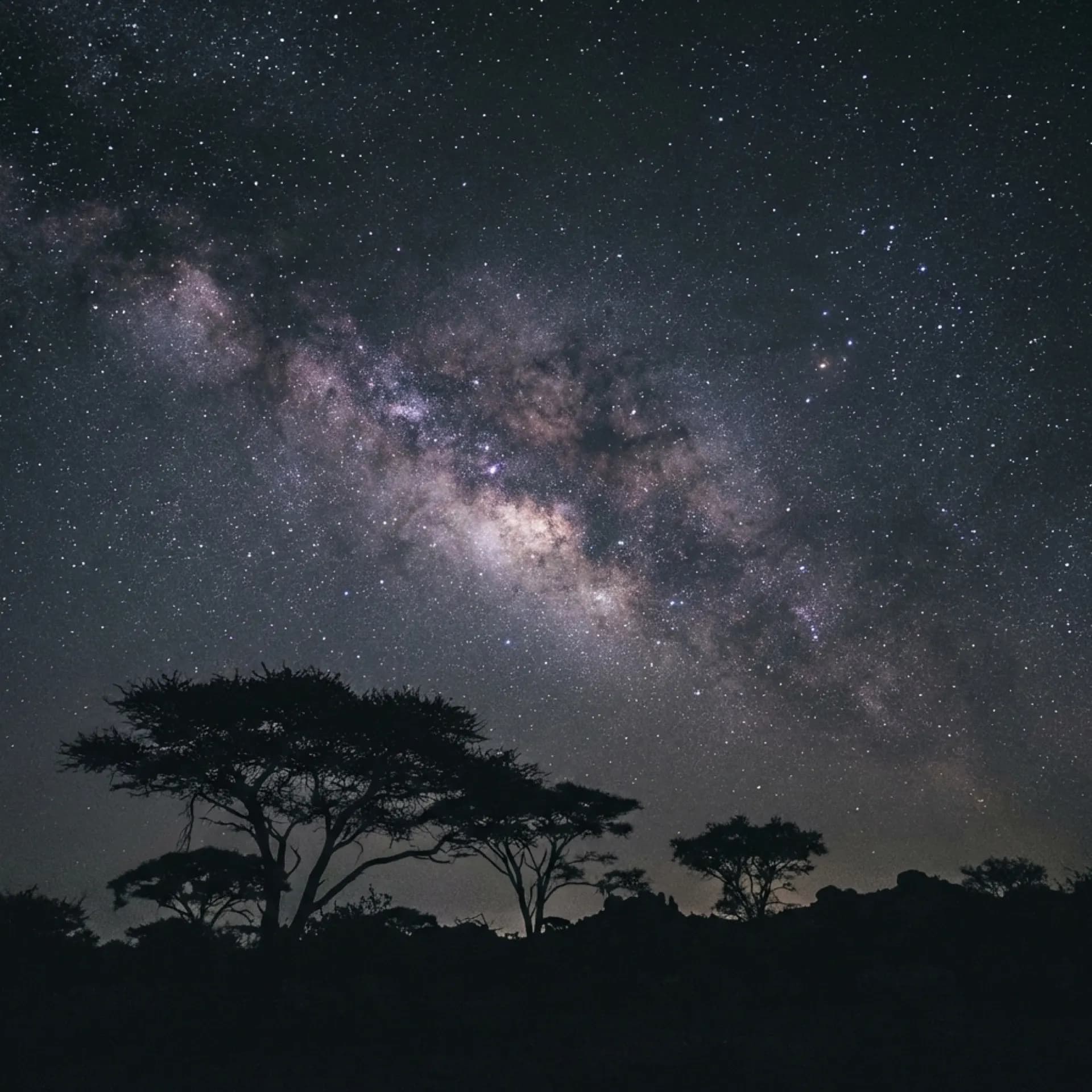
Our "Charcoal Sky" is one of our most precious resources. With zero light pollution, the Milky Way doesn't just appear; it looms. It is a physical presence—a dusty, glittering ribbon that stretches from one horizon to the other, so bright it casts faint shadows on the ground.
What You'll See: A Southern Hemisphere Treasure
The Marico night sky is particularly spectacular because of our position in the Southern Hemisphere. You have access to celestial objects invisible to stargazers in Europe or North America:
- The Milky Way Core — The galactic center, visible from April to October, appears as a dense, glowing bulge directly overhead
- The Magellanic Clouds — Two satellite galaxies of the Milky Way, visible as fuzzy patches to the naked eye
- The Southern Cross (Crux) — The iconic constellation used for navigation since ancient times
- Alpha Centauri — The nearest star system to our Sun, just 4.37 light-years away
- The Coalsack Nebula — A dark dust cloud silhouetted against the Milky Way, known to indigenous cultures across the southern hemisphere
- Omega Centauri — The largest globular cluster visible from Earth, containing over 10 million stars
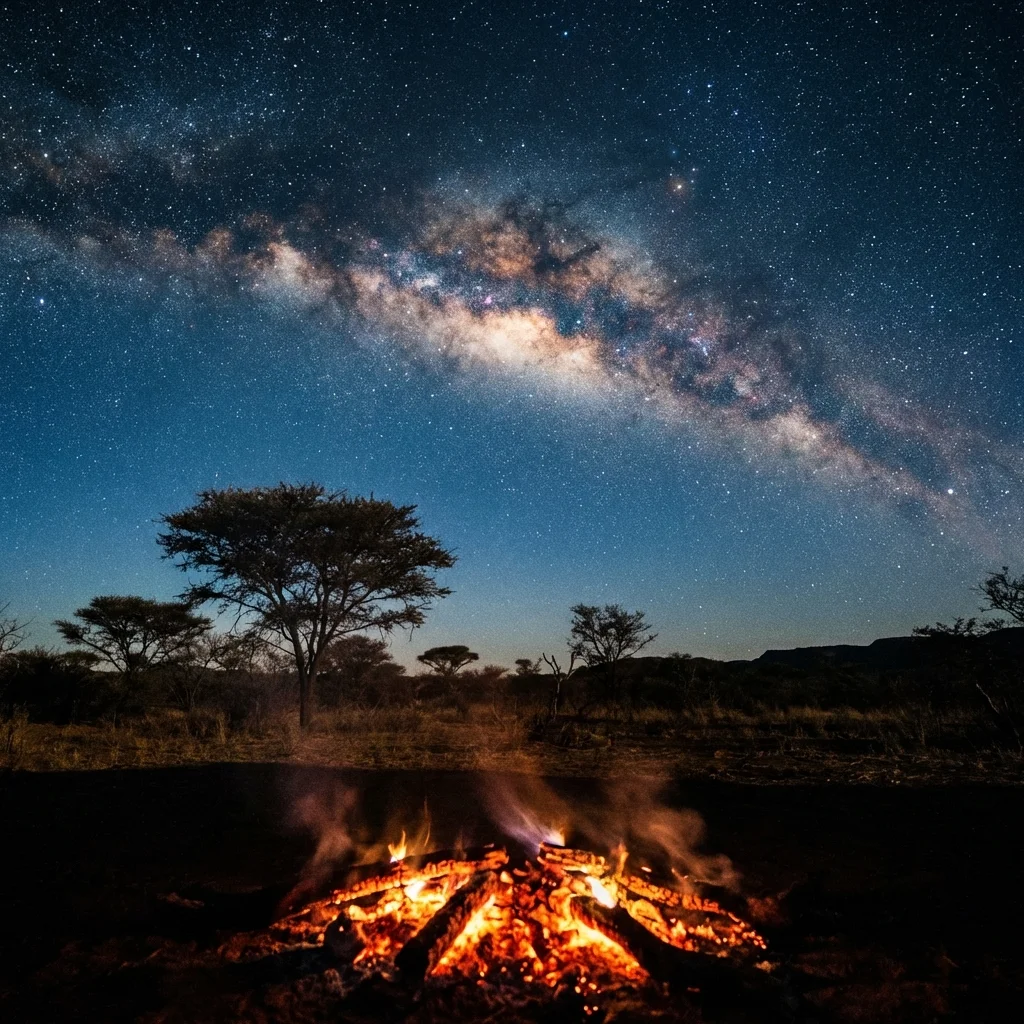
The Infinite Vault — Milky Way over the Marico
Deep Time Observation: A Practice
We encourage what we call Deep Time Observation. This is not casual stargazing—it is a practice, almost meditative in nature. Here's how it works:
First, give your eyes 20-30 minutes to fully adapt to the darkness. Avoid looking at any screens or bright lights during this time. Your pupils will dilate, and your night vision will gradually awaken receptors that remain dormant in the lit world. The sky you see after 30 minutes is fundamentally different from the one you saw in the first minute.
Once adapted, you'll begin to perceive structure within the Milky Way—the dark rifts, the star clouds, the subtle color variations between blue-white giant stars and older, reddish ones. You will see satellites cross the sky every few minutes. On a good night, you might catch several shooting stars without even trying.
"The cosmos is within us. We are made of star-stuff. We are a way for the universe to know itself."
Best Months for Stargazing
While every clear night at Rocking Giraffe offers spectacular stargazing, some periods are particularly rewarding:
- April - September (Dry Season) — Clear, crisp winter skies with minimal atmospheric moisture. The Milky Way core is visible, rising in the east during autumn evenings.
- May - July — Peak Milky Way season. The galactic center passes directly overhead around midnight.
- August — The Perseid meteor shower (though less prominent in the south) and excellent planetary viewing.
- December - January — Summer storms can clear the air dramatically, and the Geminid meteor shower puts on a show.
New moon periods are obviously best—check the lunar calendar when planning your booking.
Stargazing at Rocking Giraffe
Every chalet at Rocking Giraffe is positioned for optimal sky viewing. Your private patio faces away from any light sources, and we provide:
- Comfortable reclining chairs for extended viewing sessions
- A printed constellation guide specific to the Southern Hemisphere
- A red-light flashlight (to preserve night vision while navigating)
- Clear weather? We'll light a fire pit—embers only, no flames—so you can stargaze in warmth
For serious astronomers, we recommend bringing your own telescope. The stable atmosphere and lack of light pollution make the Marico an exceptional observing site.
The Soundscape of Darkness
Stargazing in the Marico is not just visual—it's auditory. As you recline under the stars, the bushveld night symphony unfolds around you:
The rhythmic chirp of crickets. The croaking of frogs at the distant waterhole. The occasional whoop of a spotted hyena. The eerie, ascending yelp of a black-backed jackal. And sometimes, on very still nights, the deep, resonant roar of a lion from a neighboring reserve, carried kilometers on the wind.
This is what we call the Expensive Silence—a silence so rich, so layered with natural sound, that it feels like a luxury. It is the opposite of the dead, compressed silence of urban nights.
Astrophotography in the Marico
The Marico's dark skies attract astrophotographers from across South Africa. If you're planning to shoot:
- Bring a sturdy tripod and a camera capable of manual exposure (even smartphones with night modes can capture impressive results)
- Wide-angle lenses (14-24mm) work best for Milky Way panoramas
- Experiment with ISO 3200-6400 and 15-25 second exposures
- The lodge structures, camel thorn trees, and fire pits make excellent foreground subjects
We're happy to advise on the best positions around the property for your compositions. Just ask.
Ready to trade the screen for the sky? Book your stay and experience the Charcoal Sky for yourself.
Frequently Asked Questions
Can you see the Milky Way from Johannesburg?
Unfortunately, no. Light pollution in Johannesburg and Pretoria washes out all but the brightest stars. To see the Milky Way clearly, you need to travel at least 2-3 hours from the city into a dark sky area like the Groot Marico.
What is the best time of year to stargaze in South Africa?
The dry winter months (May-August) offer the clearest skies and the best views of the Milky Way's galactic center. However, any new moon period with clear weather will provide excellent stargazing.
Do I need special equipment?
No. The naked eye is the best instrument for appreciating the scale and majesty of the night sky. Binoculars can enhance the experience by revealing star clusters and the moons of Jupiter. Telescopes are wonderful but not necessary.
Is stargazing suitable for children?
Absolutely. Children are often more patient and more awed by the night sky than adults. We find that stargazing becomes a treasured family activity—a rare moment of shared wonder without screens.